Honeywell
- joe14085
- Feb 4
- 3 min read
How Focusing on Software and Connected Technologies Transformed the Business
Honeywell (HON) has long been a major player in industries like aerospace and manufacturing. But by the mid-2010s, the company found itself in a challenging position. The traditional manufacturing sector was seeing slower growth, and Honeywell needed a way to evolve to remain competitive in an increasingly digital world. The company decided to pivot its focus towards software and connected technologies, fundamentally transforming its business model.
Slower Growth in Legacy Markets
In the mid-2010s, Honeywell faced a challenge common to many industrial companies—its legacy markets, such as aerospace and process automation, were maturing, leading to slower growth prospects. Competitors were increasingly leveraging software and IoT (Internet of Things) technologies to improve operational efficiency and product offerings. To stay competitive, Honeywell needed to embrace digital transformation.
Shifting to Software and Connected Technologies
Honeywell made a strategic decision to pivot its business towards software-driven solutions and connected technologies. In 2016, the company launched a major initiative to integrate software and IoT across its product lines, branding this effort as "Honeywell Connected Enterprise." This initiative was aimed at transforming Honeywell from a traditional industrial manufacturer into a leader in connected technologies, offering software solutions for industrial automation, smart buildings, and more.
The company also invested in acquiring software firms that would enhance its capabilities. For instance, Honeywell acquired Nextnine, a cybersecurity solutions provider for industrial companies, to strengthen its position in the fast-growing industrial cybersecurity market.
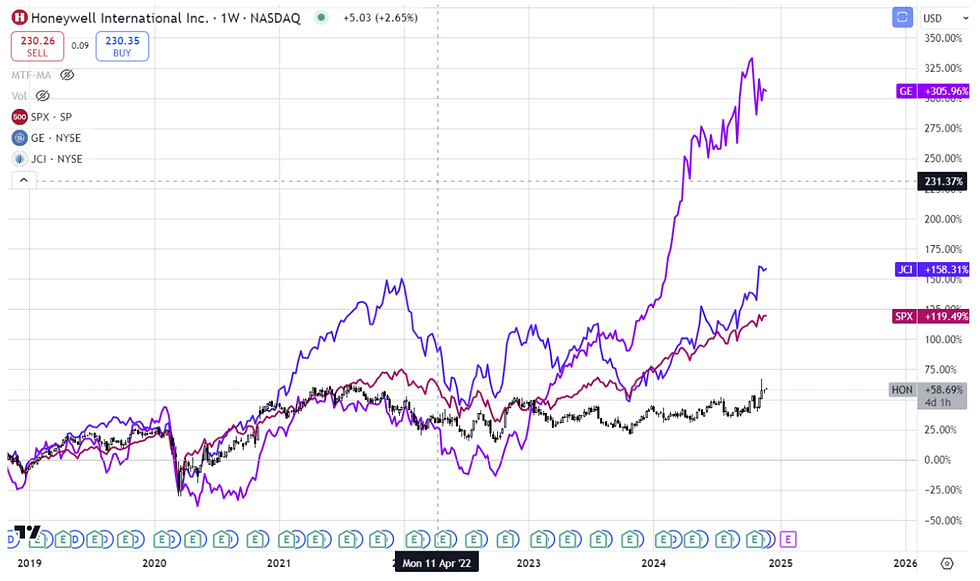
Source: Tradingview
Honeywell share price performance compared to its 2 direct rivals and SP500 Index.
From Hardware to Software
Honeywell’s shift wasn’t just about adding software capabilities—it involved changing the entire mindset of the company. The company began focusing on creating "software-as-a-service" (SaaS) solutions that could help its clients improve efficiency and reduce costs. Honeywell Forge, a cloud-based platform launched in 2019, was a key part of this transformation, providing data analytics and operational intelligence for industries like aviation, manufacturing, and energy.
Honeywell Forge helped companies monitor their operations in real time, predict maintenance needs, and improve productivity through data-driven insights. This shift to offering software and connected solutions enabled Honeywell to expand its customer base to include not only traditional industrial clients but also businesses looking for digital transformation.
Growth, Margins, and Financial Performance
So, how did Honeywell’s strategic pivot impact the business?
Revenue Growth: The new focus on software and connected technologies started paying off. By 2019, Honeywell’s software-driven revenue represented more than 20% of its total sales, contributing significantly to the company’s top-line growth. Revenue increased from $39.3 billion in 2016 to $41.8 billion in 2019, indicating steady growth fueled by the new offerings.

Margins: The shift to higher-margin software and services helped improve Honeywell's overall profitability. Software products tend to have better margins than traditional hardware, and Honeywell's operating margins improved as its revenue mix shifted towards digital solutions.

Honeywell gross profit margin compared to its industry rivals.
Source: Finbox
Return on Invested Capital (ROIC): Initially, the investments in software capabilities and acquisitions put pressure on ROIC. However, as the new revenue streams started to grow, ROIC improved, reflecting the success of the digital transformation.


Source: Alpha Spread
Economic Profit: The shift to software and connected solutions allowed Honeywell to generate greater economic profit. Higher-margin services and subscription-based revenues provided more consistent and predictable cash flows, which supported sustainable profitability over the long term.

From Manufacturing Giant to Digital Innovator
Honeywell's decision to focus on software and connected technologies was a pivotal moment that changed the company’s trajectory. By embracing IoT, cybersecurity, and software-as-a-service, Honeywell redefined itself in an era where digital solutions are key to driving value. The company's focus on digital transformation helped it stay competitive, improve financial performance, and become a leader in industrial software. Honeywell's story is a reminder that even established industry leaders must be willing to evolve—and sometimes, the best way forward is to embrace the technologies of the future.
References
Honeywell Financial Reports. Available at: Macrotrends
Honeywell Acquires Nextnine for Industrial Cybersecurity. Available at: BusinessWire
Honeywell Connected Enterprise Overview. Available at: Honeywell.com
Honeywell Forge and Digital Transformation. Available at: Forbes
Honeywell Stock Performance. Available at: Yahoo Finance


Comments